
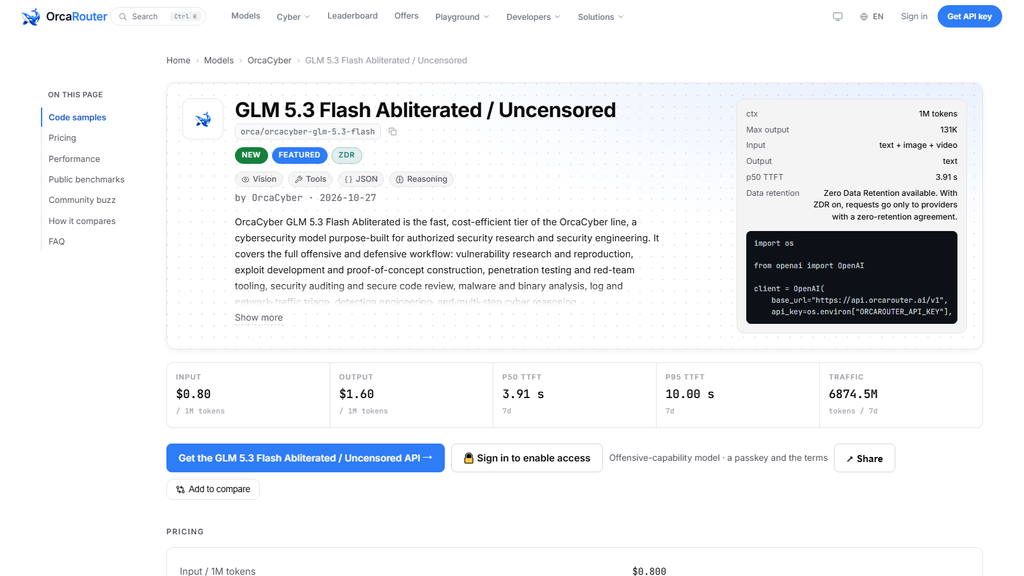
On OrcaRouter‘s cyber tier, the GLM 5.3 Flash abliterated benchmarks are five rows: CyberBench 67.9, GPQA Diamond 91.2, LiveCodeBench 80.5, SWE-bench 92 and Terminal-Bench 2.1 84.3 [VENDOR].
Across all eleven cards there are sixteen distinct benchmark names. Only four of them appear on more than one card.
GLM 5.3 Flash’s five rows are among the most isolated in the set. Three are unique to it. That makes the card simultaneously well-documented and hard to place, and the absence of an ExploitGym row is the sharpest example of why.
The sixteen names
| benchmark | cards publishing it | scores |
| GPQA Diamond | 4 | 88.6 – 91.7 |
| Terminal-Bench 2.1 | 3 | 84.3 – 90.6 |
| CyberGym | 2 | 88.1, 95.1 |
| DeepSWE v1.1 | 2 | 67.9, 74.2 |
| SEC-Bench Pro | 2 | 47.5, 62.8 |
| ExploitGym | 1 | 15.3 |
| SWE-bench | 1 | 92.0 |
| SWE-bench Pro | 1 | 62.5 |
| CyberBench | 1 | 67.9 |
| LiveCodeBench | 1 | 80.5 |
| LiveCodeBench v6 | 1 | 91.9 |
| Toolathlon Verified | 1 | 73.5 |
| TAU-Bench Airline | 1 | 68.0 |
| AA-LCR | 1 | 79.7 |
| Vibe Code Bench v1.1 | 1 | 73.9 |
| DeepSWE 1.1 | 1 | 58.7 |
[VENDOR] for every score, read from the eleven cards’ public model data on 2026-11-15.
Two rows deserve a note before anything else. `DeepSWE v1.1` and `DeepSWE 1.1` are the same benchmark under two spellings, so the real overlap is five names rather than four. And `SWE-bench` (92.0) is a different benchmark from `SWE-bench Pro` (62.5) — a 29.5-point gap that is entirely a difference in task, not in model.
What the overlap tells you
A benchmark table is only comparable within a column. Sixteen names across eleven cards means the tier has two kinds of row: the shared ones, which let you rank cards, and the unique ones, which let you describe one card and nothing more.
Ranking on shared rows produces three usable orderings.
GPQA Diamond — four cards, a 3.1-point spread from 88.6 (MiniMax) to 91.7 (Qwen). A tight cluster. The row is nearly a tie and tells you almost nothing about which card to buy.
Terminal-Bench 2.1 — three cards, a 6.3-point spread from 84.3 (GLM 5.3 Flash) to 90.6 (DeepSeek). More signal, and the ordering is the reverse of the GPQA ordering, which is the useful part.
CyberGym and SEC-Bench Pro — two cards each, and the two orderings contradict. MiMo beats DeepSeek by 7.0 on CyberGym and loses by 15.3 on SEC-Bench Pro. A card that wins on one security benchmark and loses on the other is not better or worse; it is differently shaped, and two rows cannot resolve the shape.
Everything else in the table is a single card describing itself.
Why ExploitGym is the row that matters most
ExploitGym appears once, on DeepSeek V4.1 Flash, at 15.3 [VENDOR].
It is the lowest score in the entire tier and it is the only row that measures the hardest thing security models are asked to do. The task: take a known vulnerability and produce a working exploit. Not identify it, not describe it, not write a patch — weaponise it.
15.3% means the card succeeds roughly one time in seven. That is a real capability and it is a long way from reliable.
Now the point about GLM 5.3 Flash. Its CyberBench 67.9 is an aggregate over offensive and defensive security work. If the card’s offensive-exploitation capability were as weak as DeepSeek’s 15.3, CyberBench would not show it — an aggregate over many subtasks can hide a near-zero on one.
The card could be at 15 on exploit construction or at 60. There is no row to say which, and no third party has published one. A security team evaluating it for offensive work is therefore choosing on an absence.
That is not a criticism of the model. It is a criticism of the evidence, and on a tier where every card is a month old, it is the state of the art.
What a buyer can do about it
Three moves, in order of cost.
Read the shared rows for ranking, the unique rows for fit. GPQA and Terminal-Bench tell you where a card sits; SWE-bench 92 tells you what it is unusually good at. Do not use the first to argue about the second.
Treat a missing row as unmeasured, not as zero. GLM 5.3 Flash is not bad at exploit development; it is untested at it, on the public record. The distinction changes a decision — an untested card goes into a pilot, a bad card does not.
Run the benchmark yourself on the smallest possible task set. Five exploit-construction tasks, three runs each, scored by whether the exploit works. That is fifteen calls at $0.80 input on the flash tier, and it produces the row nobody publishes.
The third is the only one that turns an absence into information, and it costs less than the meeting where the decision would otherwise be made.
What the five rows do establish
The card is a software engineer first and a security researcher second, and the five rows say it three times.
SWE-bench 92 is the highest score any card on the tier publishes, on any benchmark. It is the card’s strongest single claim.
LiveCodeBench 80.5 is 11.5 points under it, which is the usual gap between writing code and solving algorithmic problems.
Terminal-Bench 2.1 84.3 is 7.7 points under SWE-bench, and it is the row that says the card can drive a shell — the capability an autonomous agent needs.
GPQA Diamond 91.2 is within a point of the top, and it is the row least specific to security.
CyberBench 67.9 is 24.1 points under the top, and it is the only row that speaks directly to the card’s stated purpose.
Read together: strong engineering, strong reasoning, strong agentic control, adequate security knowledge, and no evidence at all on the hardest security task.
The one comparison that is legitimate
Across the four cards that publish GPQA Diamond, the spread is 3.1 points — small enough that the row is close to noise.
Across the three that publish Terminal-Bench 2.1, the spread is 6.3 points and the ordering is meaningful.
Only two cards publish a security benchmark in common, and there the spreads are large: 7.0 on CyberGym, 15.3 on SEC-Bench Pro. Those are the numbers with the most information in them, and they involve two of the eight abliterated cards.
The rest of the tier — six abliterated cards and all three post-trained ones — publishes no shared security row at all. That is the structural fact about this shelf: the security evidence is thin and fragmented, and any ranking of eleven cards on security is being built from at most two data points.
What to ask for
If you are choosing a security model from published rows, three requests are worth making of any vendor.
Publish the same three security benchmarks on every card. CyberGym, SEC-Bench Pro and ExploitGym on all of them would make the tier rankable. At present it is not.
Publish the evaluation date with the score. Every card here does, and the gaps run from 11 to 63 days before release — which is long enough that most of the rows describe a checkpoint rather than the build being sold.
Publish a reproduction. No row in this table has been independently verified. The first vendor to publish a harness and a seed set takes the tier.
None of those is a model feature. All three are procurement levers, and they are the ones that would change a buying decision.
The short version
Sixteen benchmark names across eleven cards, five of them shared and eleven unique. GLM 5.3 Flash publishes five rows and three are unique to it.
Its strongest claim is SWE-bench 92, the highest score anywhere in the tier. Its security row is CyberBench 67.9, and the row that would test the hardest security task — ExploitGym, published once at 15.3 — is absent.
Treat the absence as unmeasured rather than zero, rank cards on the shared rows, and spend fifteen calls producing the row nobody publishes. The tier’s security evidence is two data points wide, and that is the most useful thing to know about it.